Friday, 29 July 2016

Radioactive decay


Radioactive decay, also known as nuclear decay or radioactivity, is the process by which the nucleus of an unstable atom loses energy by emitting radiation, including alpha particlesbeta particlesgamma rays and conversion electrons. A material that spontaneously emits such radiation is considered radioactive.
Radioactive decay is a stochastic (i.e. random) process at the level of single atoms, in that, according to quantum theory, it is impossible to predict when a particular atom will decay.[1][2][3][4] The chance that a given atom will decay never changes, that is, it does not matter how long the atom has existed. The decay rate for a large collection of atoms, however, can be calculated from their measured decay constants or half-lives. This is the basis of radiometric dating. The half-lives of radioactive atoms have no known lower or upper limit, spanning a time range of over 55 orders of magnitude, from nearly instantaneous to far longer than the age of the universe. A radioactive source emits its decay products isotropically.[5]
There are many different types of radioactive decay (see table below). A decay, or loss of energy from the nucleus, results when an atom with one type of nucleus, called the parent radionuclide (or parent radioisotope[note 1]), transforms into an atom with a nucleus in a different state, or with a nucleus containing a different number of protons and neutrons. The product is called the daughter nuclide. In some decays, the parent and the daughter nuclides are differentchemical elements, and thus the decay process results in the creation of an atom of a different element. This is known as a nuclear transmutation.
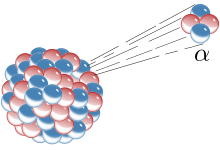
The first decay processes to be discovered were alpha decay, beta decay, and gamma decay. Alpha decay occurs when the nucleus ejects an alpha particle (helium nucleus). This is the most common process of emitting nucleons, but in rarer types of decays, nuclei can eject protons, or in the case of cluster decay specific nuclei of other elements. Beta decay occurs when the nucleus emits an electron or positron and a neutrino, in a process that changes a proton to a neutron or the other way about. The nucleus may capture an orbiting electron, causing a proton to convert into a neutron in a process calledelectron capture. All of these processes result in a well-defined nuclear transmutation.
By contrast, there are radioactive decay processes that do not result in a nuclear transmutation. The energy of an excited nucleus may be emitted as a gamma ray in a process called gamma decay, or be used to eject an orbital electron by its interaction with the excited nucleus, in a process called internal conversion. Highly excited neutron-rich nuclei, formed as the product of other types of decay, occasionally lose energy by way of neutron emission, resulting in a change of an element from one isotope to another.
Another type of radioactive decay results in products that are not defined, but appear in a range of "pieces" of the original nucleus. This decay, called spontaneous fission, happens when a large unstable nucleus spontaneously splits into two (and occasionally three) smaller daughter nuclei, and generally leads to the emission of gamma rays, neutrons, or other particles from those products.
For a summary table showing the number of stable and radioactive nuclides in each category, see radionuclide. There exist twenty-nine chemical elementson Earth that are radioactive. They are those that contain thirty-four radionuclides that date before the time of formation of the solar system, and are known as primordial nuclides. Well-known examples are uranium and thorium, but also included are naturally occurring long-lived radioisotopes such as potassium-40. Another fifty or so shorter-lived radionuclides, such as radium and radon, found on Earth, are the products of decay chains that began with the primordial nuclides, and ongoing cosmogenic processes, such as the production of carbon-14 from nitrogen-14 by cosmic rays. Radionuclides may also be produced artificially in particle accelerators or nuclear reactors, resulting in 650 of these with half-lives of over an hour, and several thousand more with even shorter half-lives. See this list of nuclides for a list of these, sorted by half life.

Magnetic sail


A magnetic sail or magsail is a proposed method of spacecraft propulsion which would use a static magnetic field to deflect charged particles radiated by the Sun as a plasma wind, and thus impart momentum to accelerate the spacecraft. A magnetic sail could also thrust directly against planetary and solar magnetospheres.

History

The magnetic sail was proposed by Dana Andrews and Robert Zubrin working in collaboration in 1988. At that time, Andrews was working on a concept to use a magnetic scoop to gather ions to provide propellant for a nuclear electric ion drive spacecraft, allowing the craft to operate in the same manner of a Bussard ramjet, but without the need for a proton-proton fusion propulsion drive. He asked Zubrin to help him compute the drag that the magnetic scoop would create against the interplanetary medium. Zubrin agreed, but found that the drag created by the scoop would be much greater than the thrust created by the ion drive. He therefore proposed that the ion drive component of the system be dropped, and the device simply used as a sail. Andrews agreed, and the magsail was born. The two then proceeded to elaborate their analysis of the magsail for interplanetary, interstellar, and planetary orbital propulsion in a series of papers published from 1988 through the 1990s.

Solar sail


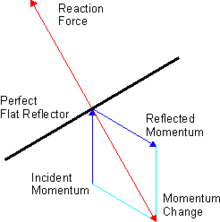
Solar sails (also called light sails or photon sails) are a form of spacecraft propulsion uses radiation pressure exerted by sunlight on large mirrors. A useful analogy may be a sailing boat; the light exerting a force on the mirrors is akin to a sail being blown by the wind. High-energy laser beams could be used as an alternative light source to exert much greater force than would be possible using sunlight, a concept known as beam sailing.


Solar sail craft offer the possibility of low-cost operations combined with long operating lifetimes. Since they have few moving parts and use no propellant, they can potentially be used numerous times for delivery of payloads.
Solar sails use a phenomenon that has a proven, measured effect on spacecraft. Solar pressure affects all spacecraft, whether in interplanetary space or in orbit around a planet or small body. A typical spacecraft going to Mars, for example, will be displaced by thousands of kilometres by solar pressure, so the effects must be accounted for in trajectory planning, which has been done since the time of the earliest interplanetary spacecraft of the 1960s. Solar pressure also affects the orientation (Aircraft attitude) of a craft, a factor that must be included in spacecraft design.
The total force exerted on an 800 by 800 meter solar sail, for example, is about 5 newtons (1.1 lbf) at Earth's distance from the Sun, making it a low-thrustpropulsion system, similar to spacecraft propelled by electric engines, but as it uses no propellant, that force is exerted almost constantly and the collective effect over time is great enough to be considered a potential manner of propelling spacecraft.

Solar panel

Solar PV modules mounted on a flat 9+10=21.    roof

Solar panel refers to a panel designed to 

absorb the sun's rays as a source of energy 

for generating electricity or heating.


photovoltaic (in short PV) module is a packaged, connected assembly of typically 6×10 solar cells. Solar Photovoltaic panels constitute the solar array of a photovoltaic system that generates and supplies solar electricity in commercial and residential applications. Each module is rated by its DC output power under standard test conditions, and typically ranges from 100 to 365 watts. The efficiency of a module determines the area of a module given the same rated output – an 8% efficient 230 watt module will have twice the area of a 16% efficient 230 watt module. There are a few commercially available solar panels available that exceed 22% efficiency[1] and reportedly also exceeding 24%.[2][3] A single solar module can produce only a limited amount of power; most installations contain multiple modules. A photovoltaic system typically includes a panel or an array of solar modules, a solar inverter, and sometimes a battery and/or solar tracker and interconnection wiring.
The price of solar power, together with batteries for storage, has continued to fall so that in many countries it is cheaper than ordinary fossil fuelelectricity from the grid (there is "grid parity").


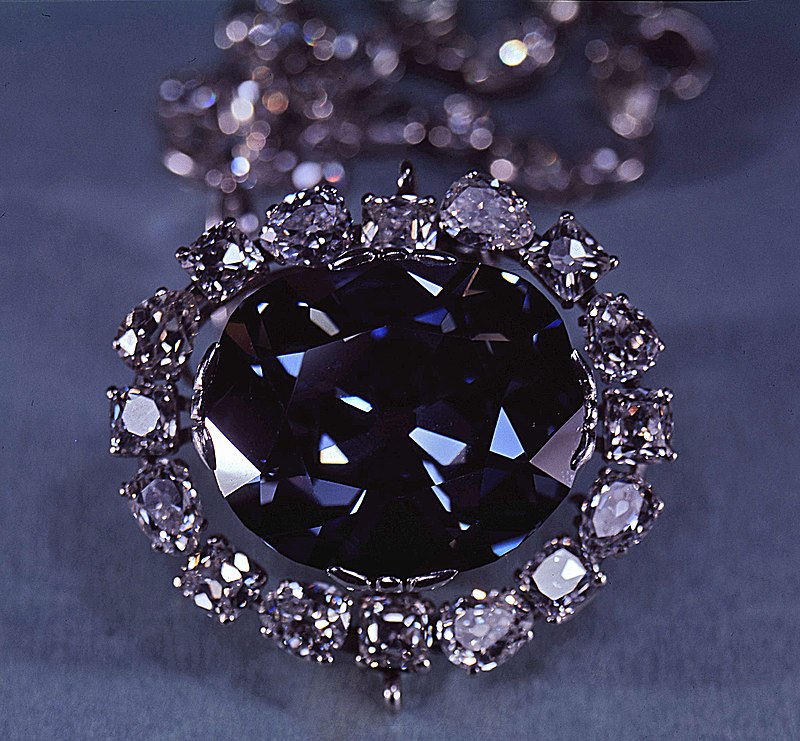
A round, clear gemstone with many facets, the main face being hexagonal, surrounded by many smaller facets.

Diamond

Diamond (pronunciation: /ˈdəmənd/ or /ˈdmənd/) is a metastable allotrope of carbon, where the carbon atoms are arranged in a variation of the face-centered cubic crystal structure called a diamond lattice. Diamond is less stable than graphite, but the conversion rate from diamond to graphite is negligible at standard conditions. Diamond is renowned as a material with superlative physical qualities, most of which originate from the strong covalent bondingbetween its atoms. In particular, diamond has the highest hardness and thermal conductivity of any bulk material. Those properties determine the major industrial application of diamond in cutting and polishing tools and the scientific applications in diamond knives and diamond anvil cells.

Because of its extremely rigid lattice, it can be contaminated by very few types of impurities, such as boron and nitrogen. Small amounts of defects or impurities (about one per million of lattice atoms) color diamond blue (boron), yellow (nitrogen), brown (lattice defects), green (radiation exposure), purple, pink, orange or red. Diamond also has relatively high optical dispersion (ability to disperse light of different colors).

Picture of a diamond.

Most natural diamonds are formed at high temperature and pressure at depths of 140 to 190 kilometers (87 to 118 mi) in the Earth's mantle. Carbon-containing minerals provide the carbon source, and the growth occurs over periods from 1 billion to 3.3 billion years (25% to 75% of the age of the Earth). Diamonds are brought close to the Earth's surface through deep volcanic eruptions by magma, which cools into igneous rocks known as kimberlites andlamproites. Diamonds can also be produced synthetically in a HPHT method which approximately simulates the conditions in the Earth's mantle. An alternative, and completely different growth technique is chemical vapor deposition (CVD). Several non-diamond materials, which include cubic zirconia andsilicon carbide and are often called diamond simulants, resemble diamond in appearance and many properties. Special gemological techniques have been developed to distinguish natural diamonds, synthetic diamonds, and diamond simulants. The word is from the ancient Greek ἀδάμας – adámas"unbreakable".


What is Glass made out of?

Beadmaking, Lampworking & Glass Blowing
Glass is made from a mixture of sand, lime and soda. When these ingredients are heated together, they form a liquid glass. This liquid glass is made into sheets by cooling and flattening. To make objects like vases, craftsmen blow into a glob of liquid glass with the help of a long tube.

Plate Glass made by Rolling :

    Sand, lime and soda are heated together in a furnace to make liquid glass. Rollers are used to flatten glass into sheets, which are first cooled, then cut.

Plate Glass made by Floating :

    Liquid glass from a furnace is floated and slowly cooled on the surface of liquid tin. After the glass has cooled down, it is cut into pieces.

Handmade Glassware :

    Vases, ornaments and other intricate glass objects are made by a glass-blower. The glass-blower uses a metal blowpipe which has a glob of hot glass at the end of it. A glass blower then blows the soft glass into shape.

Glass has many uses :

    Glasses, window panes, mirrors are few of the many things that are made from glass. Glass is not only useful, but can look beautiful too. Windows made of stained glass are works of art.
Additional Information :
    Other glass-making ingredients can include alumina, lead oxide, salt-petre and zinc oxide which are used to make different types of glass. In the production of plate glass, waste glass from a previous melt is also added, making up 5 to 40 percent of the mixture. Melting takes place in giant furnaces, from where molten glass is floated or rolled into sheets.
Things To Do
  • Identify different glass objects in your house and notice how each one looks and feels different.
  • Try making a visit to a glass factory or inquire about a glass-blower and see how they give shape to objects.
  • Try looking through different glass objects. What do you see?

Biogas

Biogas typically refers to a mixture of different gases produced by the breakdown of organic matter in the absence of oxygen. Biogas can be produced from raw materials such as agricultural waste, manuremunicipal wasteplant materialsewagegreen waste or food waste. Biogas is a renewable energy source and in many cases exerts a very small carbon footprint.
Biogas can be produced by anaerobic digestion with anaerobic organisms, which digest material inside a closed system, or fermentation of biodegradable materials.
Biogas is primarily methane (CH
4
) and carbon dioxide (CO2) and may have small amounts of hydrogen sulfide (H
2
S
), moisture and siloxanes. The gases methane,hydrogen, and carbon monoxide (CO) can be combusted or oxidized with oxygen. This energy release allows biogas to be used as a fuel; it can be used for any heating purpose, such as cooking. It can also be used in a gas engine to convert the energy in the gas into electricity and heat.
Biogas can be compressed, the same way natural gas is compressed to CNG, and used to power motor vehicles. In the UK, for example, biogas is estimated to have the potential to replace around 17% of vehicle fuel.[3] It qualifies for renewable energy subsidies in some parts of the world. Biogas can be cleaned and upgraded to natural gas standards, when it becomes bio-methane. Biogas is considered to be a renewable resource because its production-and-use cycle is continuous, and it generates no net carbon dioxide. Organic material grows, is converted and used and then regrows in a continually repeating cycle. From a carbon perspective, as much carbon dioxide is absorbed from the atmosphere in the growth of the primary bio-resource as is released when the material is ultimately converted to energy.