Showing posts with label Educaton. Show all posts

Sunday, 24 July 2016

Satellite


In the context of spaceflight, a satellite is an artificial object which has been intentionally placed into orbit. Such objects are sometimes called artificial satellites to distinguish them from natural satellites such as Earth's Moon.
The world's first artificial satellite, the Sputnik 1, was launched by the Soviet Union in 1957. Since then, thousands of satellites have been launched into orbit around the Earth. Some satellites, notably space stations, have been launched in parts and assembled in orbit. Artificial satellites originate from more than 40 countries and have used the satellite launching capabilities of ten nations. About a thousand satellites are currently operational, whereas thousands of unused satellites and satellite fragments orbit the Earth as space debris. A few space probes have been placed into orbit around other bodies and become artificial satellites to the Moon,Mercury, Venus, Mars, Jupiter, Saturn, Vesta, Eros, Ceres,[1] and the Sun.
Satellites are used for a large number of purposes. Common types include military and civilian Earth observation satellites,communications satellites, navigation satellites, weather satellites, and research satellites. Space stations and human spacecraft in orbit are also satellites. Satellite orbits vary greatly, depending on the purpose of the satellite, and are classified in a number of ways. Well-known (overlapping) classes include low Earth orbit, polar orbit, and geostationary orbit.
About 6,600 satellites have been launched. The latest estimates are that 3,600 remain in orbit.[2] Of those, about 1,000 are operational;[3][4] the rest have lived out their useful lives and are part of the space debris. Approximately 500 operational satellites are in low-Earth orbit, 50 are in medium-Earth orbit (at 20,000 km), the rest are in geostationary orbit (at 36,000 km).[5]
Satellites are propelled by rockets to their orbits. Usually the launch vehicle itself is a rocket lifting off from a launch pad on land. In a minority of cases satellites are launched at sea (from a submarine or a mobile maritime platform) or aboard a plane (see air launch to orbit).
Satellites are usually semi-independent computer-controlled systems. Satellite subsystems attend many tasks, such as power generation, thermal control, telemetry, attitude control and orbit control.

Universe

NASA-HS201427a-HubbleUltraDeepField2014-20140603.jpg

The Universe is all of time and space and its contents.[9][10][11][12] It includes planets, moons, minor planets, stars, galaxies, the contents of intergalactic space, and all matter and energy. The observable universe is about 28 billion parsecs (91 billionlight-years) in diameter.[3] The size of the entire Universe is unknown, but there are many hypotheses about the composition and evolution of the Universe.[13]
The earliest scientific models of the Universe were developed by ancient Greek and Indian philosophers and weregeocentric, placing the Earth at the center of the Universe.[14][15] Over the centuries, more precise astronomical observations led Nicolaus Copernicus (1473–1543) to develop the heliocentric model with the Sun at the center of the Solar System. In developing the law of universal gravitation, Sir Isaac Newton (NS: 1643–1727) built upon Copernicus's work as well as observations by Tycho Brahe (1546–1601) and Johannes Kepler's (1571–1630) laws of planetary motion. Further observational improvements led to the realization that our Solar System is located in the Milky Way galaxy and is one of many solar systems and galaxies. It is assumed that galaxies are distributed uniformly and the same in all directions, meaning that the Universe has neither an edge nor a center. Discoveries in the early 20th century have suggested that the Universe had a beginning and that it is expanding[16] at an increasing rate.[17] The majority of mass in the Universe appears to exist in an unknown form called dark matter.
The Big Bang theory, the prevailing cosmological model describing the development of the Universe, states that space and time were created in the Big Bang and were given a fixed amount of energy and matter that becomes less dense as space expands. After the initial expansion, the Universe cooled, allowing the first subatomic particles to form and then simpleatoms. Giant clouds later merged through gravity to form stars. Assuming that the standard model of the Big Bang theory is correct, the age of the Universe is measured to be 13.799±0.021 billion years.[2]
There are many competing hypotheses about the ultimate fate of the Universe and about what, if anything, preceded the Big Bang, while other physicists and philosophers refuse to speculate, doubting that information about prior states will ever be accessible. Some physicists have suggested various multiverse hypotheses, in which the Universe might be one among many universes that likewise exist.

Milky Way

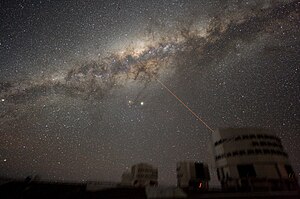
ESO-VLT-Laser-phot-33a-07.jpg

The Milky Way is the galaxy that contains our Solar System.[18][19][20][nb 1] Its name "milky" is derived from its appearance as a dim glowing band arching across the night sky whose individual stars cannot be distinguished by the naked eye. The term "Milky Way" is a translation of the Latin via lactea, from the Greek γαλαξίας κύκλος (galaxías kýklos, "milky circle").[21][22][23]From Earth, the Milky Way appears as a band because its disk-shaped structure is viewed from within. Galileo Galilei first resolved the band of light into individual stars with his telescope in 1610. Until the early 1920s, most astronomers thought that the Milky Way contained all the stars in the Universe. Following the 1920 Great Debate between the astronomersHarlow Shapley and Heber Curtis,[24] observations by Edwin Hubble showed that the Milky Way is just one of many galaxies—now estimated to number as many as 200 billion galaxies in the observable universe.[25][26]
The Milky Way is a barred spiral galaxy that has a diameter usually considered to be about 100,000–120,000 light-years[27]but may be 150,000–180,000 light-years.[28] The Milky Way is estimated to contain 100–400 billion stars,[29][30] although this number may be as high as one trillion.[31] There are likely at least 100 billion planets in the Milky Way.[32][33] The Solar System is located within the disk, about 27,000 light-years from the Galactic Center, on the inner edge of one of the spiral-shaped concentrations of gas and dust called the Orion Arm. The stars in the inner ≈10,000 light-years form a bulge and one or more bars that radiate from the bulge. The very center is marked by an intense radio source, named Sagittarius A*, which is likely to be a supermassive black hole.
Stars and gases at a wide range of distances from the Galactic Center orbit at approximately 220 kilometers per second. The constant rotation speed contradicts the laws of Keplerian dynamics and suggests that much of the mass of the Milky Way does not emit or absorb electromagnetic radiation. This mass has been termed "dark matter".[34] The rotational period is about 240 million years at the position of the Sun.[15] The Milky Way as a whole is moving at a velocity of approximately 600 km per second with respect to extragalactic frames of reference. The oldest stars in the Milky Way are nearly as old as the Universe itself and thus likely formed shortly after the Dark Ages of the Big Bang.[9]
The Milky Way has several satellite galaxies and is part of the Local Group of galaxies, which is a component of the Virgo Supercluster, which is itself a component of the Laniakea Supercluster.

Dark matter


Dark matter is an unexplained type of matter comprising approximately 27% of the mass and energy in the observable universe[1]that is not accounted for by dark energy, baryonic matter (ordinary matter), and neutrinos.[2] The name refers to the fact that it does not emit or interact with electromagnetic radiation, such as light, and is thus invisible to the entire electromagnetic spectrum.[3]Although dark matter has not been directly observed, its existence and properties are inferred from its gravitational effects such as the motions of visible matter, gravitational lensing, its influence on the universe's large-scale structure, and its effects in the cosmic microwave background. Dark matter is transparent to electromagnetic radiation and/or is so dense and small that it fails to absorb or emit enough radiation to be detectable with current imaging technology.
Estimates of masses for galaxies and larger structures via dynamical and general relativistic means are much greater than those based on the mass of the visible "luminous" matter.[4]
The standard model of cosmology indicates that the total mass–energy of the universe contains 4.9% ordinary matter, 26.8% dark matter and 68.3% dark energy.[5][6] Thus, dark matter constitutes 84.5%[note 1] of total mass, while dark energy plus dark matter constitute 95.1% of total mass–energy content.[7][8][9][10] The great majority of ordinary matter in the universe is also unseen, since visible stars and gas inside galaxies and clusters account for less than 10% of the ordinary matter contribution to the mass-energy density of the universe.[11]
The dark matter hypothesis plays a central role in current modeling of cosmic structure formation and galaxy formation and evolution and on explanations of the anisotropies observed in the cosmic microwave background (CMB). All these lines of evidence suggest that galaxies, clusters of galaxies, and the universe as a whole contain far more matter than that which is observable via electromagnetic signals.[12]
The most widely accepted hypothesis on the form for dark matter is that it is composed of weakly interacting massive particles(WIMPs) that interact only through gravity and the weak force.[13]
Although the existence of dark matter is generally accepted by most of the astronomical community, a minority of astronomers [14]argue for various modifications of the standard laws of general relativity, such as MOND, TeVeS, and Conformal gravity[15] that attempt to account for the observations without invoking additional matter.[16]
Many experiments to detect proposed dark matter particles through non-gravitational means are under way.

Star


A star is a luminous sphere of plasma held together by its own gravity. The nearest star to Earth is the Sun. Many other stars are visible to the naked eye from Earth during the night, appearing as a multitude of fixed luminous points in the sky due to their immense distance from Earth. Historically, the most prominent stars were grouped into constellations and asterisms, the brightest of which gained proper names. Astronomers have assembled star catalogues that identify the known stars and provide standardized stellar designations. However, most of the stars in the Universe, including all stars outside our galaxy, the Milky Way, are invisible to the naked eye from Earth. Indeed, most are invisible from Earth even through the most powerful telescopes.
For at least a portion of its life, a star shines due to thermonuclear fusion of hydrogen into helium in its core, releasing energy that traverses the star's interior and then radiates into outer space. Almost all naturally occurring elements heavier than helium are created bystellar nucleosynthesis during the star's lifetime, and for some stars by supernova nucleosynthesis when it explodes. Near the end of its life, a star can also contain degenerate matter. Astronomers can determine the mass, age, metallicity (chemical composition), and many other properties of a star by observing its motion through space, its luminosity, and spectrum respectively. The total mass of a star is the main factor that determines its evolution and eventual fate. Other characteristics of a star, including diameter and temperature, change over its life, while the star's environment affects its rotation and movement. A plot of the temperature of many stars against their luminosities produces a plot known as a Hertzsprung–Russell diagram (H–R diagram). Plotting a particular star on that diagram allows the age and evolutionary state of that star to be determined.
A star's life begins with the gravitational collapse of a gaseous nebula of material composed primarily of hydrogen, along with helium and trace amounts of heavier elements. When the stellar core is sufficiently dense, hydrogen becomes steadily converted into helium through nuclear fusion, releasing energy in the process.[1] The remainder of the star's interior carries energy away from the core through a combination of radiative and convective heat transfer processes. The star's internal pressure prevents it from collapsing further under its own gravity. When the hydrogen fuel at the core is exhausted, a star of mass 0.4 times greater than the Sun's[2] will expand to become ared giant. In some cases, it will fuse heavier elements at the core or in shells around the core. As the star expands it throws a part of its mass, enriched with those heavier elements, into the interstellar environment, to be recycled later as new stars.[3] Meanwhile, the core becomes a stellar remnant: a white dwarf, a neutron star, or if it is sufficiently massive a black hole.
Binary and multi-star systems consist of two or more stars that are gravitationally bound and generally move around each other in stable orbits. When two such stars have a relatively close orbit, their gravitational interaction can have a significant impact on their evolution.[4] Stars can form part of a much larger gravitationally bound structure, such as a star cluster or a galaxy.
Meteoroid

A meteoroid is a small rocky or metallic body travelling through outer space. Meteoroids are significantly smaller than asteroids, and range in size from small grains to 1 meter-wide objects.[1] Objects smaller than this are classified as micrometeoroids orspace dust.[1][2][3] Most are fragments from comets or asteroids, whereas others are collision impact debris ejected from bodies such as the Moon or Mars.
When a comet, asteroid, or meteoroid enters the Earth's atmosphere at a speed typically in excess of 20 km/s (72,000 km/h; 45,000 mph), aerodynamic heating of that object produces a streak of light, both from the glowing object and the trail of glowing particles that it leaves in its wake. This phenomenon is called a meteor or "shooting star". A series of many meteors appearing seconds or minutes apart and appearing to originate from the same fixed point in the sky is called a meteor shower. If that object withstands ablation from its passage through the atmosphere as a meteor and impacts with the ground, it is then called ameteorite.

Comet


Hale–Bopp seen from Croatia in 1997

A comet is an icy small Solar System body that, when passing close to the Sun, heats up and begins to outgas, displaying a visible atmosphere or coma, and sometimes also a tail. These phenomena are due to the effects of solar radiation and thesolar wind upon the nucleus of the comet. Comet nuclei range from a few hundred metres to tens of kilometres across and are composed of loose collections of ice, dust, and small rocky particles. The coma and tail are much larger and, if sufficiently bright, may be seen from the Earth without the aid of a telescope. Comets have been observed and recorded since ancient times by many cultures.
Comets usually have highly eccentric elliptical orbits, and they have a wide range of orbital periods, ranging from several years to potentially several millions of years. Short-period comets originate in the Kuiper belt or its associated scattered disc, which lie beyond the orbit of Neptune. Long-period comets are thought to originate in the Oort cloud, a spherical cloud of icy bodies extending from outside the Kuiper belt to halfway to the next nearest star. Long-period comets are directed towards the Sun from the Oort cloud by gravitational perturbations caused by passing stars and the galactic tide. Hyperbolic cometsmay pass once through the inner Solar System before being flung out to interstellar space.
Comets are distinguished from asteroids by the presence of an extended, gravitationally unbound atmosphere surrounding their central nucleus. This atmosphere has parts termed the coma (the central part immediately surrounding the nucleus) and the tail (a typically linear section consisting of dust or gas blown out from the coma by the Sun's light pressure or outstreaming solar wind plasma). However, extinct comets that have passed close to the Sun many times have lost nearly all of their volatile ices and dust and may come to resemble small asteroids.[1] Asteroids are thought to have a different origin from comets, having formed inside the orbit of Jupiter rather than in the outer Solar System.[2][3] The discovery ofmain-belt comets and active centaurs has blurred the distinction between asteroids and comets.
As of November 2014 there are 5,253 known comets,[4] a number that is steadily increasing. However, this represents only a tiny fraction of the total potential comet population, as the reservoir of comet-like bodies in the outer Solar System (in theOort cloud) is estimated to be one trillion.[5][6] Roughly one comet per year is visible to the naked eye, though many of these are faint and unspectacular.[7] Particularly bright examples are called "Great Comets". Comets have been visited by unmanned probes such as the European Space Agency's Rosetta, which became the first ever to land a robotic spacecraft on a comet,[8] and NASA's Deep Impact, which blasted a crater on Comet Tempel 1 to study its interior.

Saturn

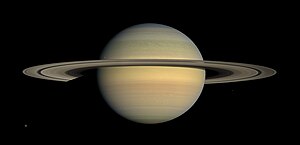
Saturn during Equinox.jpg

Saturn is the sixth planet from the Sun and the second-largest in the Solar System, after Jupiter. It is a gas giant with an average radius about nine times that of Earth.[10][11] Although only one-eighth the average density of Earth, with its larger volume Saturn is just over 95 times more massive.[12][13][14] Saturn is named after the Roman god of agriculture; itsastronomical symbol (♄) represents the god's sickle.
Saturn's interior is probably composed of a core of iron–nickel and rock (silicon and oxygen compounds). This core is surrounded by a deep layer of metallic hydrogen, an intermediate layer of liquid hydrogen and liquid helium, and finally outside the Frenkel line a gaseous outer layer.[15] Saturn has a pale yellow hue due to ammonia crystals in its upper atmosphere. Electrical current within the metallic hydrogen layer is thought to give rise to Saturn's planetary magnetic field, which is weaker than Earth's, but has a magnetic moment 580 times that of Earth due to Saturn's larger size. Saturn's magnetic field strength is around one-twentieth of Jupiter's.[16] The outer atmosphere is generally bland and lacking in contrast, although long-lived features can appear. Wind speeds on Saturn can reach 1,800 km/h (500 m/s), higher than on Jupiter, but not as high as those on Neptune.[17]
Saturn has a prominent ring system that consists of nine continuous main rings and three discontinuous arcs and that is composed mostly of ice particles with a smaller amount of rocky debris and dust. Sixty-two[18] moons are known to orbit Saturn, of which fifty-three are officially named. This does not include the hundreds of moonlets comprising the rings. Titan, Saturn's largest moon, and the second-largest in the Solar System, is larger than the planet Mercury, although less massive, and is the only moon in the Solar System to have a substantial atmosphere.

Venus


Venus in approximately true colour, a nearly uniform pale cream, although the image has been processed to bring out details.[1] The planet's disc is about three-quarters illuminated. Almost no variation or detail can be seen in the clouds.

Venus is the second planet from the Sun, orbiting it every 224.7 Earth days.[14] It has the longest rotation period (243 days) of any planet in the Solar System and rotates in the opposite direction to most other planets. It has no natural satellite. It is named after the Roman goddess of love and beauty. It is the second-brightest natural object in the night sky after the Moon, reaching anapparent magnitude of −4.6, bright enough to cast shadows.[15] Because Venus is an inferior planet from Earth, it never appears to venture far from the Sun; its elongation reaches a maximum of 47.8°.
Venus is a terrestrial planet and is sometimes called Earth's "sister planet" because of their similar size, mass, proximity to the Sun, and bulk composition. It is radically different from Earth in other respects. It has the densest atmosphere of the four terrestrial planets, consisting of more than 96% carbon dioxide. The atmospheric pressure at the planet's surface is 92 times that of Earth. Venus is by far the hottest planet in the Solar System, with a mean surface temperature of 735 K (462 °C; 863 °F), even thoughMercury is closer to the Sun. Venus is shrouded by an opaque layer of highly reflective clouds of sulfuric acid, preventing its surface from being seen from space in visible light. It may have had water oceans in the past,[16][17] but these would have vaporized as the temperature rose due to a runaway greenhouse effect.[18] The water has probably photodissociated, and the free hydrogen has been swept into interplanetary space by the solar wind because of the lack of a planetary magnetic field.[19] Venus's surface is a dry desertscape interspersed with slab-like rocks and is periodically resurfaced by volcanism.
As one of the brightest objects in the sky, Venus has been a major fixture in human culture for as long as records have existed. It has been made sacred to gods of many cultures, and has been a prime inspiration for writers and poets as the "morning star" and "evening star". Venus was the first planet to have its motions plotted across the sky, as early as the second millennium BC,[20] and was a prime target for early interplanetary exploration as the closest planet to Earth. It was the first planet beyond Earth visited by a spacecraft (Mariner 2) in 1962, and the first to be successfully landed on (by Venera 7) in 1970. Venus's thick clouds render observation of its surface impossible in visible light, and the first detailed maps did not emerge until the arrival of the Magellan orbiter in 1991. Plans have been proposed for rovers or more complex missions, but they are hindered by Venus's hostile surface conditions.