Showing posts with label Hacking. Show all posts

Friday, 22 July 2016

Types of Hacker:


White hat
Main article: White hat
A white hat hacker breaks security for non-malicious reasons, either to test their own security system, perform penetration tests or vulnerability assessments for a client - or while working for a security company which makes security software. The term is generally synonymous with ethical hacker, and the EC-Council,[17] among others, have developed certifications, courseware, classes, and online training covering the diverse arena of ethical hacking.[16]

Black hat

Main article: Black hat
A "black hat" hacker is a hacker who "violates computer security for little reason beyond maliciousness or for personal gain" (Moore, 2005).[18] The term was coined by Richard Stallman, to contrast the maliciousness of a criminal hacker versus the spirit of playfulness and exploration of hacker culture, or the ethos of the white hat hacker who performs hacking duties to identify places to repair.[19] Black hat hackers form the stereotypical, illegal hacking groups often portrayed in popular culture, and are "the epitome of all that the public fears in a computer criminal".[20]

Grey hat

Main article: Grey hat
A grey hat hacker lies between a black hat and a white hat hacker. A grey hat hacker may surf the Internet and hack into a computer system for the sole purpose of notifying the administrator that their system has a security defect, for example. They may then offer to correct the defect for a fee.[20] Grey hat hackers sometimes find the defect of a system and publish the facts to the world instead of a group of people. Even though grey hat hackers may not necessarily perform hacking for their personal gain, unauthorized access to a system can be considered illegal and unethical.

Elite hacker

A social status among hackers, elite is used to describe the most skilled. Newly discovered exploits circulate among these hackers. Elite groups such as Masters of Deceptionconferred a kind of credibility on their members.[21]

Script kiddie

A script kiddie (also known as a skid or skiddie) is an unskilled hacker who breaks into computer systems by using automated tools written by others (usually by other black hat hackers), hence the term script (i.e. a prearranged plan or set of activities) kiddie (i.e. kid, child—an individual lacking knowledge and experience, immature),[22] usually with little understanding of the underlying concept.

Neophyte

A neophyte ("newbie", or "noob") is someone who is new to hacking or phreaking and has almost no knowledge or experience of the workings of technology and hacking.[20]

Blue hat

A blue hat hacker is someone outside computer security consulting firms who is used to bug-test a system prior to its launch, looking for exploits so they can be closed. Microsoftalso uses the term BlueHat to represent a series of security briefing events

hacker:


software


Hacker is a term used by some to mean "a clever programmer" and by others, especially those in popular media, to mean "someone who tries to break into computer systems."

1) Eric Raymond, compiler of The New Hacker's Dictionary, defines a hacker as a clever programmer. A "good hack" is a clever solution to a programming problem and "hacking" is the act of doing it. Raymond lists five possible characteristics that qualify one as a hacker, which we paraphrase here:

  • A person who enjoys learning details of a programming language or system
  • A person who enjoys actually doing the programming rather than just theorizing about it
  • A person capable of appreciating someone else's hacking
  • A person who picks up programming quickly
  • A person who is an expert at a particular programming language or system, as in "UNIX hacker"
Raymond deprecates the use of this term for someone who attempts to crack someone else's system or otherwise uses programming or expert knowledge to act maliciously. He prefers the term cracker for this meaning.
2) The term hacker is used in popular media to describe someone who attempts to break into computer systems. Typically, this kind of hacker would be a proficient programmer or engineer with sufficient technical knowledge to understand the weak points in a security system. For more on this usage, see cracker.
click on the link below to know about cracker

How To HACK Any Wifi Network Password (Use CMD)


cmd basic hacking tips and tricks:


 Free Hacking Course: Go from Beginner to Expert Hacker Today!


Hacking Tools:

There now are more than 100,000 known viruses with more appearing virtually daily. The myriad of hackers and their nefarious deeds can affect any computer owner whether an occasional home user, e-mailer, student, blogger, or a network administrator on site or on the internet. No matter your level of computer use, you must protect your computer, business, or even your identity. The best way to know how to protect your computer is to understand the hacker's tools and recognize their damage.

Viruses, Exploits, Worms, and More

The term computer "virus" originated to describe machine code command inserted into a computer's memory that, on execution, copies itself into other programs and files on the computer. Depending on the hacker's intent, the design of a virus can merely be an inconvenience or have very serious consequences up to a potential catastrophe.
Generally, a virus is a piece of software, a series of data, or a command sequence that exploits a bug, glitch, or vulnerability. Each example is appropriately termed an "exploit." An exploit causes unintended or unanticipated behavior to occur in a computer's operating system or applications while propagating itself within the computer.
An exploit and operates through a network security vulnerability or "hole" without previous access to the vulnerable system is a "remote" exploit. An exploit that needs prior access to a system is termed a "local" exploit. These are usually intended to increase the hacker's access privileges beyond those granted by a system administrator.
Worms are simply viruses that send copies over network connections. A bomb resides silently in a computer's memory until set off by a date or action. A Trojan horse is a malicious program that cannot reproduce itself, but is distributed by CD or e-mail.

Protect Your Computer: Avoid Computer Holes/Vulnerabilities

Install only trusted software and delete unknown emails. If you have any doubt about a piece of software's function, do not install it. If you receive e-mails from random people's names, resist your curiosity and do not open it, just delete it.
Under no conditions download or open attachments from anyone that you do not know and even then be cautious. Banks and most companies that create online personal accounts will not send you attachments. If they do, it is probably best to go to the company site and request the download or at least see if it is legitimate. Avoid adult web sites, a hacker's paradise.
Whether in your e-mail or online, do not click on ads. If the ad is of interest, find the site. Be careful with what you physically put into your computer. This is especially true for shared R/W CDs, USB hard disks, or flash drives. This is an easy path for a virus to follow from computer to computer.

Protection: Install Anti-Virus Software

Anti-virus software searches for evidence of the presence of viral programs, worm, bombs, and Trojan horses by checking for the characteristic appearances or behaviors that is typical of these programs. When found the program logs its discovery, its type, often its name or an identifier, and it potential for damage. The anti-virus software then eliminates or isolates/quarantines the infected files. For the individual, commercial software is relatively inexpensive; however, there are free anti-virus programs available.
Since new viruses appear almost daily with new code it is imperative that you update you antivirus program often to keep up with these threats; therefore, make sure to set your program to update automatically. To avoid the annoyance of computer slowdown schedule full scale scans late at night.
The same is true for your Windows Operating System. Very often, your OS is where hackers discover the holes to exploit. Of course, in an ever-continuing battle, this software is continuously updated with security patches.
Finally, secure your wireless network with a router that has a built in firewall. Almost all wireless routers are set to no security when first installed. Log into the router and at least set it to basic security with a strong password to replace the factory setting that any hacker knows. A firewall or router that is not configured properly or non-existent allows hackers to scan passwords, e-mails, or files that cross your network connection.

Related Articles 


What is Hacking?

Hacking is the practice of modifying the features of a system, in order to accomplish a goal outside of the creator's original purpose. The person who is consistently engaging in hacking activities, and has accepted hacking as a lifestyle and philosophy of their choice, is called a hacker.
Computer hacking is the most popular form of hacking nowadays, especially in the field of computer security, but hacking exists in many other forms, such as phone hacking, brain hacking, etc. and it's not limited to either of them.
Due to the mass attention given to blackhat hackers from the media, the whole hacking term is often mistaken for any security related cyber crime. This damages the reputation of all hackers, and is very cruel and unfair to the law abiding ones of them, from who the term itself originated. The goal of this website is to introduce people the true philosophy and ethics of hackers, hopefully clearing their name and giving them the social status they deserve.
If you support the cause of this website, you can contribute by sharing it with your friends, using any of the buttons below.

Saturday, 9 April 2016

                    100+ Hacking Tutorials


 In the following file, all references made to the name Unix, may also be
substituted to the Xenix operating system.

  Brief history:  Back in the early sixties, during the development of third
generation computers at MIT, a group of programmers studying the potential of
computers, discovered their ability of performing two or more tasks
simultaneously.  Bell Labs, taking notice of this discovery, provided funds for
their developmental scientists to investigate into this new frontier.  After
about 2 years of developmental research, they produced an operating system they
called "Unix".

  Sixties to Current:  During this time Bell Systems installed the Unix system
to provide their computer operators with the ability to multitask so that they
could become more productive, and efficient.  One of the systems they put on the
Unix system was called "Elmos".  Through Elmos many tasks (i.e.  billing,and
installation records) could be done by many people using the same mainframe.

  Note:  Cosmos is accessed through the Elmos system.

  Current:  Today, with the development of micro computers, such multitasking
can be achieved by a scaled down version of Unix (but just as powerful).
Microsoft,seeing this development, opted to develop their own Unix like system
for the IBM line of PC/XT's.  Their result they called Xenix (pronounced
zee-nicks).  Both Unix and Xenix can be easily installed on IBM PC's and offer
the same functions (just 2 different vendors).

  Note:  Due to the many different versions of Unix (Berkley Unix, Bell System
III, and System V the most popular) many commands following may/may not work.  I
have written them in System V routines.  Unix/Xenix operating systems will be
considered identical systems below.

  How to tell if/if not you are on a Unix system:  Unix systems are quite common
systems across the country.  Their security appears as such:

Login;     (or login;)
password:

  When hacking on a Unix system it is best to use lowercase because the Unix
system commands are all done in lower- case.

  Login; is a 1-8 character field.  It is usually the name (i.e.  joe or fred)
of the user, or initials (i.e.  j.jones or f.wilson).  Hints for login names can
be found trashing the location of the dial-up (use your CN/A to find where the
computer is).

  Password:  is a 1-8 character password assigned by the sysop or chosen by the
user.

      Common default logins
   --------------------------

   login;       Password:

   root         root,system,etc..
   sys          sys,system
   daemon       daemon
   uucp         uucp
   tty          tty
   test         test
   unix         unix
   bin          bin
   adm          adm
   who          who
   learn        learn
   uuhost       uuhost
   nuucp        nuucp

  If you guess a login name and you are not asked for a password, and have
accessed to the system, then you have what is known as a non-gifted account.  If
you guess a correct login and pass- word, then you have a user account.  And,
if you guess the root password, then you have a "super-user" account.  All Unix
systems have the following installed to their system:  root, sys, bin, daemon,
uucp, adm

  Once you are in the system, you will get a prompt.  Common prompts are:


$

%

#


  But can be just about anything the sysop or user wants it to be.

  Things to do when you are in:  Some of the commands that you may want to try
follow below:

  who is on (shows who is currently logged on the system.)
  write name (name is the person you wish to chat with)
  To exit chat mode try ctrl-D.
  EOT=End of Transfer.
  ls -a (list all files in current directory.)
  du -a (checks amount of memory your files use;disk usage)
  cd\name (name is the name of the sub-directory you choose)
  cd\ (brings your home directory to current use)
  cat name (name is a filename either a program or documentation your username
has written)

  Most Unix programs are written in the C language or Pascal since Unix is a
programmers' environment.

  One of the first things done on the system is print up or capture (in a
buffer) the file containing all user names and accounts.  This can be done by
doing the following command:


cat /etc/passwd


  If you are successful you will a list of all accounts on the system.  It
should look like this:

root:hvnsdcf:0:0:root dir:/:
joe:majdnfd:1:1:Joe Cool:/bin:/bin/joe
hal::1:2:Hal Smith:/bin:/bin/hal

  The "root" line tells the following info :

login name=root
hvnsdcf   = encrypted password
0         = user group number
0         = user number
root dir  = name of user
/         = root directory

  In the Joe login, the last part "/bin/joe " tells us which directory is his
home directory (joe) is.

  In the "hal" example the login name is followed by 2 colons, that means that
there is no password needed to get in using his name.

  Conclusion:  I hope that this file will help other novice Unix hackers obtain
access to the Unix/Xenix systems that they may find.  There is still wide growth
in the future of Unix, so I hope users will not abuse any systems (Unix or any
others) that they may happen across on their journey across the electronic
highways of America.  There is much more to be learned about the Unix system
that I have not covered.  They may be found by buying a book on the Unix System
(how I learned) or in the future I may write a part II to this........


                       Hacking Hotmail
                            Accounts

Type USER and then the victim´s username
c. Type PASS and then the guess a password
d. Repeat that until U have found the correct password. 
!. This is called brute force hacking and requires patience. 
It´s better than trying to guess the victims password on 
hotmail homepage only because it´s faster. 
____
I_2_I  - The Best way 
a. Get the username of the victim (It usually stands in the adress-field
)
b. Then type " www.hotmail.com/cgi-bin/start/victimsusername "
c. U´re in! 
!. This hack only work if U are on the same network or computer as the 
victim and if he don´t log out. 
____
I_3_I  - The old way 
a. Go to http://www.hotmail/proxy.html
b. Now type the victims username. (press login)
c. Look at the source code.
d. On the fifth row U should find "action=someadress"
e. Copy that adress and paste it into the adress-field
f. You are in... 
!. As you can see it´s a long procedure and the victim have 
plenty of time to log out. 
____
I_4_I  - Another... 
a. Go to hotmail´s homepage
b. Copy the source code.
c. Make a new html file with the same code but change method=post to
method=enter
d. "view" the page
e. Change the adress to www.hotmail.com/ (don´t press enter!)
f. Make the victim type in his username and password
g. Look in the adress-field. There you´ll see ...&password:something... 
!. This is the way I use, because it lets you know the password. 
(If he exits the browser U can see the password in the History folder!)

READ!
Hotmail´s sysops have changed the "system" so that the victim may log
out even
if U are inside his/her account. So don´t waste U´r time!

---

So you want to get some hotmail passwords?  
This is pretty easy to do once you have got the hang of it.  
If you are a beginner, I wouldn't make this your first attempt at 
hacking.  When you need to do is use a port surfer and surf over to 
port 80.  While there, you have to try and mail the user that you 
want the password from.  It is best to mail them using the words 
"We" and "Here at Hotmail..."  Most suckers fall for this and end 
up giving out their password.  There is another way to also, you can 
get an anon mailer, and forge the addres as staff@hotmail.com.  But 
you have to change the reply address to go to a different addres 
like user@host.com.  The person that you are trying to get the pass 
from MUST respond to that letter for the mail to be forwarded to you. 
Have text like "Please reply to this letter with the subject "PASSWORD"
and underneith please include your user name and password.  
If you have trouble Loging in withing the next few days, this is 
only because we are updating our mail servers but no need to worry, 
your mail will still be there.  Even though the server may be down 
for an hour.  From the staff at Hotmail, Thank You."


Friday, 8 April 2016


                          hacking a phone


           Ethical Hacking Tutorials 2 System Requirements


                    Ethical Hacking Tutorials 1 Welcome


               Complete Free Hacking Course: Go from Beginner                                to Expert Hacker Today!

              How To Hcak Wireless Networks


How to hack wireless networks

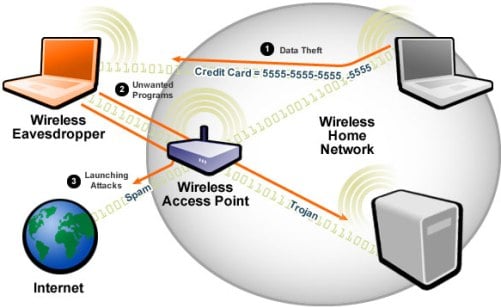
Wireless networks are accessible to anyone within the router’s transmission radius. This makes them vulnerable to attacks. Hotspots are available in public places such as airports, restaurants, parks etc.
In this tutorial, we will introduce you to common techniques used toexploit weaknesses in wireless network security implementations. We will also look at some of the counter measures you can put in place to protect against such attacks.


Topics covered in this tutorial


What is a wireless network?

A wireless network is a network that uses radio waves to link computers and other devices together. The implementation is done at the layer 1 (physical layer) of the OSI model.

How to access a wireless network?

You will need a wireless network enabled device such as a laptop, tablet, smart phones etc. You will also need to be within the transmission radius of a wireless network access point. Most devices (if the wireless network option is turned on) will provide you with a list of available networks. If the network is not password protected, then you just have to click on connect. If it is password protected, then you will need the password to gain access.

Wireless Network Authentication

Since the network is easily accessible to everyone with a wireless network enabled device, most networks are password protected. Let’s look at some of the most commonly used authentication techniques.

WEP

WEP is the acronym for Wired Equivalent Privacy. It was developed for IEEE 802.11 WLAN standards. Its goal was to provide the privacy equivalent to that provided by wired networks. WEP works by encrypting the data been transmitted over the network to keep it safe from eavesdropping.
WEP Authentication
Open System Authentication (OSA) – this methods grants access to station authentication requested based on the configured access policy.
Shared Key Authentication (SKA) – This method sends to an encrypted challenge to the station requesting access. The station encrypts the challenge with its key then responds. If the encrypted challenge matches the AP value, then access is granted.
WEP Weakness
WEP has significant design flaws and vulnerabilities.
  • The integrity of the packets is checked using Cyclic Redundancy Check (CRC32).CRC32 integrity check can be compromised by capturing at least two packets. The bits in the encrypted stream and the checksum can be modified by the attacker so that the packet is accepted by the authentication system. This leads to unauthorized access to the network.
  • WEP uses RC4 encryption algorithm to create stream ciphers.The stream cipher input is made up of an initial value (IV) and a secret key. The length of theinitial value (IV) is 24 bits long while the secret key can either be 40 bits or 104 bits long. The total length of both the initial value and secret can either be 64 bits or 128 bits long.The lower possible value of the secret key makes it easy to crack it.
  • Weak Initial values combinations do not encrypt sufficiently. This makes them vulnerable to attacks.
  • WEP is based on passwords; this makes it vulnerable to dictionary attacks.
  • Keys management is poorly implemented. Changing keys especially on large networks is challenging. WEP does not provide a centralized key management system.
  • The Initial values can be reused
Because of these security flaws, WEP has been deprecated in favor of WPA

WPA

WPA is the acronym for Wi-Fi Protected Access. It is a security protocol developed by the Wi-Fi Alliance in response to the weaknesses found in WEP. It is used to encrypt data on 802.11 WLANs. It uses higher Initial Values 48 bits instead of the 24 bits that WEP uses.  It uses temporal keys to encrypt packets.
WPA Weaknesses
  • The collision avoidance implementation can be broken
  • It is vulnerable to denial of service attacks
  • Pre-shares keys use passphrases.  Weak passphrases are vulnerable to dictionary attacks.

How to Crack Wireless Networks

WEP cracking
Cracking is the process of exploiting security weaknesses in wireless networks and gaining unauthorized access. WEP cracking refers to exploits on networks that use WEP to implement security controls. There are basically two types of cracks namely;
  • Passive cracking– this type of cracking has no effect on the network traffic until the WEP security has been cracked. It is difficult to detect.
  • Active cracking– this type of attack has an increased load effect on the network traffic. It is easy to detect compared to passive cracking. It is more effective compared to passive cracking.

WEP Cracking Tools

WPA Cracking

WPA uses a 256 pre-shared key or passphrase for authentications. Short passphrases are vulnerable to dictionary attacks and other attacks that can be used to crack passwords. The following tools can be used to crack WPA keys.

General Attack types

  • Sniffing– this involves intercepting packets as they are transmitted over a network. The captured data can then be decoded using tools such as Cain & Abel.
  • Man in the Middle (MITM) Attack– this involves eavesdropping on a network and capturing sensitive information.
  • Denial of Service Attack– the main intent of this attack is to deny legitimate users network resources. FataJackcan be used to perform this type of attack. More on this in article

Cracking Wireless network WEP/WPA keys

It is possible to crack the WEP/WPA keys used to gain access to a wireless network. Doing so requires software and hardware resources, and patience. The success of such attacks can also depend on how active and inactive the users of the target network are.
We will provide you with basic information that can help you get started. Backtrack is a Linux based security operating system. It is developed on top of Ubuntu. Backtrack comes with a number of security tools. Backtrack can be used to gather information, assess vulnerabilities and perform exploits among other things.
Some of the popular tools that backtrack has includes;
  • Metasploit
  • Wireshark
  • Aircrack-ng
  • NMap
  • Ophcrack
Cracking wireless network keys requires patience and resources mentioned above. At a minimum, you will need the following tools
A wireless network adapter with the capability to inject packets (Hardware)
  • Backtrack Operating System. You can download it from here http://www.backtrack-linux.org/downloads/  (Software)
  • Be within the target network’s radius. If the users of the target network are actively using and connecting to it, then your chances of cracking it will be significantly improved.
  • Sufficient knowledge of Linux based operating systems and working knowledge of Aircrack and its various scripts.
  • Patience, cracking the keys may take a bit of sometime depending on a number of factors some of which may be beyond your control. Factors beyond your control include users of the target network using it actively as you sniff data packets.

How to Secure wireless networks

In minimize wireless network attacks; an organization can adopt the following policies
  • Changing default passwordsthat come with the hardware
  • Enabling the authentication mechanism
  • Access to the network can be restrictedby allowing only registered MAC addresses.
  • Use of strong WEP and WPA-PSK keys, a combination of symbols, number and characters reduces the chance of the keys been cracking using dictionary and brute force attacks.
  • Intrusion detection systems (IDS),systems such as WIDZ can help; network scanning, association floods and Rogue APs. http://ostatic.com/widz
  • Firewallsoftware can also help reduce unauthorized access.


Hacking Activity: Crack Wireless Password

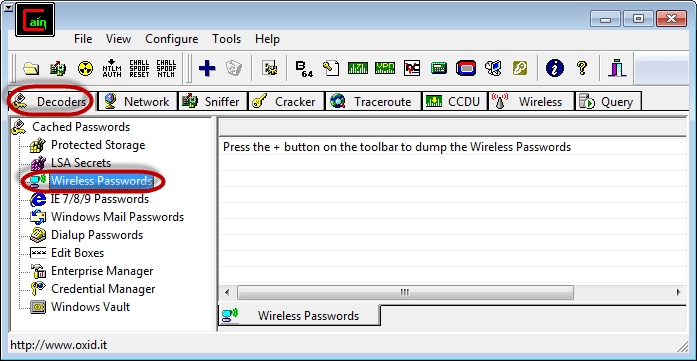
In this practical scenario, we are going touse Cain and Abel to decode the stored wireless network passwords in windows. We will also provide useful information that can be used to crack the WEP and WPA keys of wireless networks.

Decoding Wireless network passwords stored in Windows

  • Download Cain & Abel from the link provided above.
  • Open Cain and Abel
  • Ensure that the Decoders tab is selected then click on Wireless Passwords from the navigation menu on the left hand side
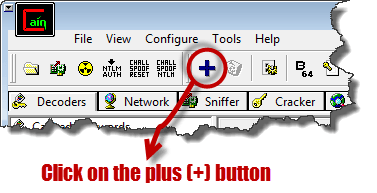
  • Click on the button with a plus sign
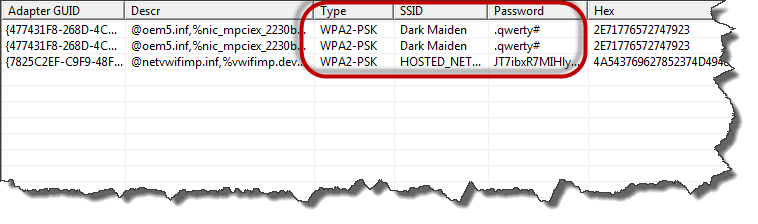
  • Assuming you have connected to a secured wireless network before, you will get results similar to the ones shown below

  • The decoder will show you the encryption type, SSID and the password that was used.

Summary

  • Wireless network transmission waves can be seen by outsiders, this possess many security risks.
  • WEP is the acronym for Wired Equivalent Privacy. It has security flaws which make it easier to break compared to other security implementations.
  • WPA is the acronym for Wi-Fi Protected Access. It has  security compared to WEP
  • Intrusion Detection Systems can help detect unauthorized access
  • A good security policy can help protect a network.

You Might Like

                Ethical Hacking Tutorials


What is Hacking ? An Introduction

Computers have become mandatory to run a successful businesses. It is not enough to have isolated computers systems; they need to be networked to facilitate communication with external businesses. This exposes them to the outside world and cybercrime. Cybercrime is using computers to commit fraudulent acts such as fraud, privacy invasion, stealing corporate/personal data etc. Cybercrimes cost many organizations millions of dollars every year. Businesses need to protect themselves against such attacks.


How can they protect themselves?
In this article, we will introduce you to ethical hacking.

Topics covered in this tutorial

What is hacking?

There are many definitions of hacking. In this article, we will define hacking as identifying weakness in computer systems and/or networks and exploiting the weaknesses to gain access. An example of hacking is using by passing the login algorithm to gain access to a system. A hacker is a person who finds and exploits weakness in computer systems and/or networks to gain access. Hackers are usually skilled computer programmers with knowledge of computer security.
 Before we go any further, let’s look at some of the most commonly used terminologies in the world of hacking.

Types of Hackers

Hackers are classified according to the intent of their actions. The following list classifies hackers according to their intent.
SymbolDescription
Ethical Hacker (White hat):A hacker who gains access to systems with a view to fix the identified weaknesses. They may also perform penetration testing and vulnerability assessments.
Cracker (Black hat):A hacker who gains unauthorized access to computer systems for personal gain. The intent is usually to steal corporate data, violate privacy rights, transfer funds from bank accounts etc.
Grey hat:A hacker who is in between ethical and black hat hackers. He/she breaks into computer systems without authority with a view to identify weaknesses and reveal them to the system owner.
Script kiddies:A non-skilled person who gains access to computer systems using already made tools.
Hacktivist:A hacker who use hacking to send social, religious, and political etc. messages. This is usually done by hijacking websites and leaving the message on the hijacked website.
Phreaker:A hacker who identifies and exploits weaknesses in telephones instead of computers.

What is Cybercrime?

Cybercrime is the use of computers and networks to perform illegal activities such as spreading computer viruses, online bullying, performing unauthorized electronic fund transfers etc.  Most cybercrimes are committed through the internet. Some cybercrimes can also be carried out using mobile phones via SMS and online chatting applications.

Type of Cybercrime

  • The following list presents the common types of cybercrimes:
  • Computer fraud:Intentional deception for personal gain via the use of computer systems.
  • Privacy violation:Exposing personal information such as email addresses, phone number, account details etc. onsocial media, websites etc.
  • Identity Theft:Stealing personal information from somebody and impersonating that person.
  • Sharing copyrighted files/information:This involves distributing copyright protected files such as eBooks and computer programs etc.
  • Electronic funds transfer:This involves gaining an un-authorized access to bank computer networks and making illegal fund transfers.
  • Electronic money laundering:This involves the use of computer to launder money.
  • ATM Fraud:This involves intercepting ATM card details such as account number and PIN numbers. These details are then used to withdraw funds from the intercepted accounts.
  • Denial of Service Attacks:This involves the use of computers in multiple locations to attack servers with a view of shutting them down.
  • Spam:Sending unauthorized emails. These emails usually contain advertisements.

What is ethical hacking?

Ethical hacking is identifying weakness in computer systems and/or computer networks and coming with counter measures that protect the weaknesses. Ethical hackers must abide by the following rules.
  • Get written permission from the owner of the computer system and/or computer network before hacking.
  • Protect the privacy of the organization been hacked.
  • Transparently report all the identified weaknesses in the computer system to the organization.
  • Inform hardware and software vendors of the identified weaknesses.

Why ethical hacking?

  • Information is one of the most valuable assets of an organization. Keeping information secure can protect an organization’s image and save an organization a lot of money.
  • Hacking can lead to loss of business for organizations that deal in finance such as PayPal. Ethical hacking puts them a step ahead of the cyber criminals who would otherwise lead to loss of business.

Legality of ethical hacking

Ethical hacking is legal if the hacker abides by the rules stipulated in the above section on the definition of ethical hacking. The International Council of E-Commerce Consultants (EC-Council) provides a certification program that tests individual’s skills. Those who pass the examination are awarded with certificates. The certificates are supposed to be renewed after some time.

Summary

  • Hacking is identifying and exploiting weaknesses in computer systems and/or computer networks.
  • Cybercrime is committing crime with the aid of computers and information technology infrastructure.
  • Ethical hacking is about improving the security of computer systems and/or computer networks.
  • Ethical hacking is legal.

You Might Like